


 Mark Cross
Time is the one resource we can never get back. For executives, business owners, and managers, mastering time management isn’t just helpful, it’s essential for growth, productivity, and work-life balance.
As motivational speaker Jim Rohn has wisely said:
“Time is more valuable than money. You can get more money, but you cannot get more time.”
“Either you run the day or the day runs you.”
In my experience working with senior executives at ZRG/Brimstone and small to medium-sized business owners through FocusCFO, one challenge is universal: there never seem to be enough hours in the day.
From endless meetings in large organizations to urgent day-to-day firefighting in smaller businesses, leaders often feel trapped in the “busyness trap," working harder but not necessarily smarter.
The good news? You can take control of your time and make every hour count.
Why Time Management Matters for Executives and Business Owners
-
Prevent burnout and reduce stress
.png?width=306&height=306&name=blog%20images%20(44).png)
-
Increase productivity without increasing hours worked
-
Focus on tasks that drive real business growth
-
Build a stronger, more empowered team
As Michael Altshuler, motivational speaker, reminds us:
“The bad news is time flies. The good news is you’re the pilot.”
Becoming the “pilot” of your own time means intentionally deciding how to spend each hour, rather than reacting to every interruption.
The Eisenhower Matrix: A Time Management Framework That Works
One of the most effective tools for prioritizing tasks and boosting productivity is the Eisenhower Matrix, which divides activities into four quadrants:
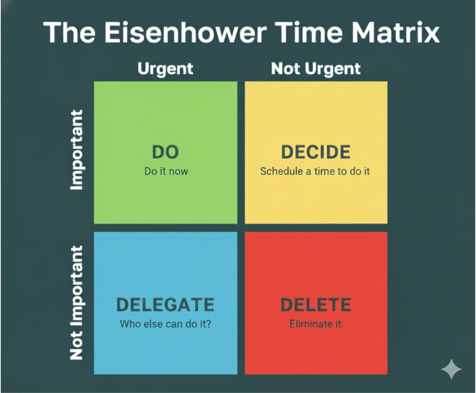
1. DO: Important & Urgent
Tasks that demand immediate attention, like critical client issues or operational emergencies, belong here. Handle these now.
2. DECIDE: Important but Not Urgent
The key quadrant for effective leaders. Strategic planning, growth initiatives, and long-term goals reduce future crises. Stephen Covey called this the most important quadrant for personal and professional effectiveness.
Pro tip: Block dedicated time in your calendar to focus exclusively on these high-impact tasks.
3. DELEGATE: Urgent but Not Important
Tasks that are urgent but don’t require your personal attention should be delegated out. Empowering your team frees your time and increases organizational value.
4. DELETE: Not Urgent & Not Important
These are distractions. Stop spending time here.
Proven Time Management Strategies for Leaders
Here are actionable techniques to maximize productivity and efficiency:
1. Time Blocking and Task Batching
Schedule focused blocks for mission-critical, non-urgent work. Batch similar tasks like emails into 2–3 sessions daily. Monotasking boosts focus, while multitasking increases errors. .png?width=265&height=265&name=blog%20images%20(45).png)
2. Accept “Good Enough” for Less Critical Tasks
Perfectionism can stall progress. While striving for excellence is important, sometimes “good enough” keeps projects moving efficiently.
3. Learn to Say No
Create “stop doing” lists as intentionally as you create to-do lists. Protect your time and focus on what truly matters.
4. Optimize Meetings with the GRPI Model
Clarify Goals, Roles, Process, and Interpersonal norms before meetings. Effective meetings save time and increase productivity.
5. The Calendar Exercise
Ensure your calendar reflects your top 3–5 priorities. Review past meetings: Could they be shortened, delegated, or eliminated? Use this insight to redesign your schedule.
Final Thoughts: Lead Your Time, Don’t Chase It
At the end of the day, time management isn’t about squeezing more tasks into your calendar, it’s about making intentional choices that align with your highest priorities. The most effective leaders aren’t the busiest; they’re the most focused.
When you consistently invest your time in what’s important, not just what’s urgent, you create space for better decisions, stronger teams, and sustainable growth. Whether that means delegating more, cutting unnecessary meetings, or protecting time for strategic thinking, small changes can produce significant results over time.
Arthur Brooks, academic and happiness expert, said it best: "Ruthlessly cut red tape and unnecessary meetings. Nothing lowers workers' well-being faster than obliging them to waste productive time."
Choose to be the pilot of your day. Your business, your team, and your future self will thank you.