


 Allison Hochman
If you've ever hired an employee and wondered, "Do I need to pay this person overtime?," you're asking exactly the right question. The answer depends entirely on whether that employee is classified as exempt or non-exempt under the Fair Labor Standards Act (FLSA).
Getting this wrong isn't just a paperwork issue. Misclassifying even one employee can result in years of back pay owed, liquidated damages, attorney's fees, and in serious cases, criminal penalties. Yet it's one of the most common payroll mistakes small and mid-size businesses make, often completely by accident.
Let's break it all down in plain English.
First Things First: What Is the FLSA?
The Fair Labor Standards Act (FLSA) is the federal law that governs minimum wage, overtime pay, recordkeeping, and child labor standards for most private and public employers in the U.S. It was enacted in 1938 and is enforced by the U.S. Department of Labor's Wage and Hour Division (WHD).
Under the FLSA, every employee falls into one of two buckets: exempt or non-exempt. These aren't just labels, they determine what legal protections and pay requirements apply to your workers.
Non-Exempt: The Default Classification
Here's something that surprises many business owners: non-exempt is the default. The FLSA assumes every employee is non-exempt unless you can prove otherwise. That means if you haven't actively confirmed an employee qualifies for an exemption, they're legally non-exempt.
Non-exempt employees are protected by the full scope of the FLSA, which means:
-
They must be paid at least the federal minimum wage ($7.25/hour as of 2025)
- They must receive overtime pay at a rate of at least 1.5 times their regular pay for every hour worked over 40 in a workweek
- Their hours must be tracked and recorded by the employer
- They can be paid hourly or on a salary, but the pay method doesn't change their overtime rights
Exempt: What It Really Means
"Exempt" means the employee is exempt from the FLSA's overtime and minimum wage requirements. But, and this is critical, an employee doesn't become exempt just because you call them a manager or pay them a salary. They must meet specific criteria set by the FLSA.
To qualify as exempt under the standard "white collar" exemptions (executive, administrative, or professional), an employee must pass all three of the following tests:
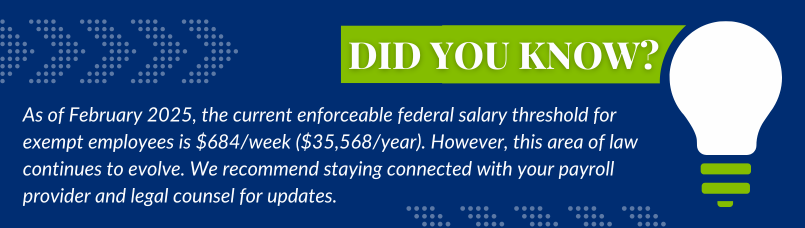
- Salary-Level Test: They must earn at least $684 per week ($35,568 annually).
- Salary-Basis Test: They must receive a predetermined, fixed salary that doesn't change based on hours worked
- Duties Test: Their primary job duties must meet the specific criteria for one of the recognized exemption categories
All three tests must be met. A high salary alone doesn't make someone exempt. And having the word "manager" in a job title doesn't either.
The Main Exempt Categories
Executive Exemption: The employee's primary duty is managing the business or a department, they regularly direct two or more other employees, and they have authority to hire, fire, or meaningfully influence those decisions.
Administrative Exemption: The employee performs office or non-manual work related to management or general business operations, and exercises discretion and independent judgment on significant matters.
Professional Exemption: The employee's work requires advanced knowledge in a field of science or learning, typically obtained through a prolonged course of specialized intellectual instruction (think: lawyers, doctors, engineers, accountants, teachers).
Other Exemptions: Outside sales employees, certain computer professionals, and highly compensated employees (currently earning $107,432+ annually) may also qualify for exemptions with slightly different criteria.
Exempt vs. Non-Exempt: Side-by-Side
|
|
Exempt |
Non-Exempt |
|
Overtime Pay |
Not required |
Required (1.5x after 40 hrs) |
|
Pay Type |
Salary (guaranteed) |
Hourly or Salary |
|
Min. Salary Threshold |
$684/week ($35,568/yr)* |
No minimum |
|
Timekeeping Required |
Not required by FLSA |
Required |
|
Minimum Wage Guarantee |
Not applicable (salary basis) |
Yes |
*As of February 2025, a federal court ruling restored the minimum salary threshold to $684/week. See the section on recent legal changes below.
The Salary Threshold Saga (And Why It Matters Right Now)
The salary threshold for exempt employees has been at the center of a lot of legal back-and-forth recently, and business owners need to understand where things stand.
For years, the threshold was $684/week ($35,568/year). In 2024, the Biden Administration's DOL issued a final rule raising that threshold in two phases, first to $844/week in July 2024, then to $1,128/week in January 2025. This would have reclassified millions of workers as non-exempt.
However, in November 2024, a federal court in Texas struck down the rule entirely. The court found the DOL exceeded its authority by setting the threshold so high that it effectively replaced the duties test. As of early 2025, the threshold has reverted to $684/week ($35,568/year), the pre-2024 level.
Source: Jackson Lewis — DOL Salary Rule Update (2025)
State Laws Can (and Often Do) Set a Higher Bar
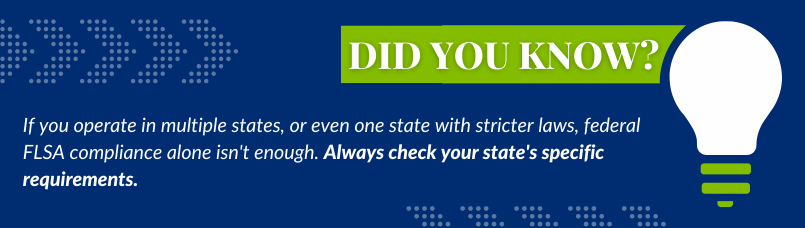
Here's where things get more complex for businesses in certain states: state overtime and classification laws can be stricter than federal law, and when they are, you must follow the state standard.
A few important examples:
- California: Requires overtime after 8 hours in a single day (not just 40 in a week). Has its own, higher salary threshold for exempt employees. Also has strict daily double-time requirements.
- New York: Has a higher minimum wage and its own salary thresholds for exempt employees that exceed the federal baseline. Employees have up to 6 years to bring wage claims under New York law.
- Colorado: Requires overtime after 12 hours in a single day and also has industry-specific exemption rules.
- Washington: Has daily overtime requirements for manufacturing and retail employees.
Source: Comprehensive Guide to Overtime Laws by State — Eddy HR
What Happens If You Misclassify an Employee?
Employee misclassification is one of the most active areas of enforcement for the Department of Labor. It's not treated as a simple mistake, it can carry serious financial and legal consequences, even if unintentional.
According to the DOL and legal experts, misclassification can result in:
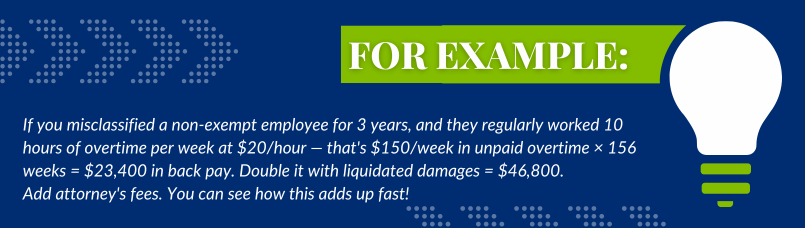
- Back wages for all unpaid overtime, potentially going back 2–3 years (3 years for willful violations)
- Liquidated damages equal to the amount of back wages owed, effectively doubling the cost
- Civil penalties up to $1,000 per violation for repeated or willful violations
- Criminal prosecution and fines up to $10,000 for willful violations
- Attorney's fees: the employer typically pays the employee's legal costs in successful claims
Sources: DOL FLSA Enforcement | Paycor — FLSA Guide
Common Misconceptions (Busted)
"My employee agreed to be classified as exempt, so we're fine."
The law doesn't care what you and an employee agree to. Exemption status is determined by job duties and salary, not mutual agreement or job title. An employee can't "sign away" their right to overtime.
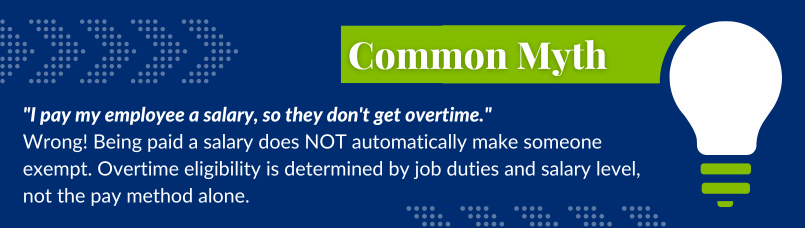
"My employee is salaried, so overtime doesn't apply."
This is the most common misunderstanding. Salary is just a pay method. Unless the employee also meets the duties test and salary threshold, they are still entitled to overtime for hours over 40.
"This person manages people, so they're a manager, and therefore exempt."
Not automatically. The executive exemption requires that managing is the primary duty, that the employee regularly supervises two or more workers, and that they have real authority over employment decisions. A shift lead who mostly runs the register isn't likely to qualify.
"We call them a 1099 contractor, so FLSA doesn't apply."
Labeling someone a contractor doesn't make them one. The DOL uses an "economic reality test" to determine whether a worker is truly an independent contractor. Misclassifying employees as independent contractors carries its own set of serious penalties, including IRS tax liabilities.
Practical Steps for Business Owners
Here's a simple framework for reviewing your classifications:
- Audit your current workforce: List all salaried employees and ask: Do they meet all three tests (salary level, salary basis, and duties)? Don't assume, verify!
- Review job descriptions: Make sure job duties actually reflect what employees do day-to-day, not just what you want them to do. Classifications must be based on actual work performed.
- Know your state laws: Confirm whether your state has a higher salary threshold, daily overtime requirements, or other rules that go beyond the FLSA.
- Track time for all non-exempt employees: The FLSA requires it. Good timekeeping protects both your employees and your business.
- When in doubt, classify as non-exempt: The employer bears the burden of proving an exemption applies. If you're not sure, the safer choice is non-exempt.
- Stay current: Salary thresholds and state laws change. Work with your payroll provider and HR/legal advisors to stay ahead of updates.
The Bottom Line
The exempt vs. non-exempt distinction isn't just legal jargon, it's a fundamental part of how you pay and manage your team. Getting it right protects your employees, protects your business, and builds the kind of workplace people want to be part of.
If you're unsure about any of your current classifications, the best time to review them is now, before a complaint is filed or an audit comes knocking.
Looking for more information? Check out the Department of Labor's Fact Sheet #17A: Exemption for Executive, Administrative, Professional, Computer & Outside Sales Employees Under the Fair Labor Standards Act (FLSA)
In need of assistance? Connect with Dominion Payroll at hello@dominionpayroll.com or 804.355.3430, we're here to help!
.png?width=666&height=222&name=ABOUT%20DP%20%20(21).png)